Bottled in Barre: The Story of Zan's and Seal Soda
Bottled in Barre: The Story of Zan's and Seal Soda traces the history of one of Barre's forgotten hometown businesses, from its founding as Zan's Sodas in 1936 to its years as Seal Soda Company and its apparent closure in 1966. The article is based on historical newspaper research conducted by Michael Boutin and information shared by local residents. The research was organized and synthesized with the assistance of OpenAI's ChatGPT to create a single, cohesive historical narrative while remaining faithful to the available source material.
7/18/20268 min read


Bottled in Barre:
The Story of Zan's and Seal Soda
The Pop of a Bottle
Today, it is difficult to imagine Barre having its own soda brand lining the shelves of stores. Yet for decades, one of the city's own companies bottled soft drinks just a few steps away from Main St, employing local residents and delivering cases of soda.
The story began during the Great Depression with a small company called Zan's Sodas. It was bought by Seal Soda Company, survived wartime rationing, expanded into one of central Vermont's leading bottlers, weathered a devastating fire, built a modern production facility in South Barre—and then quietly disappeared in 1966.
This is the story of one of Barre's forgotten hometown businesses.
A Company is Born
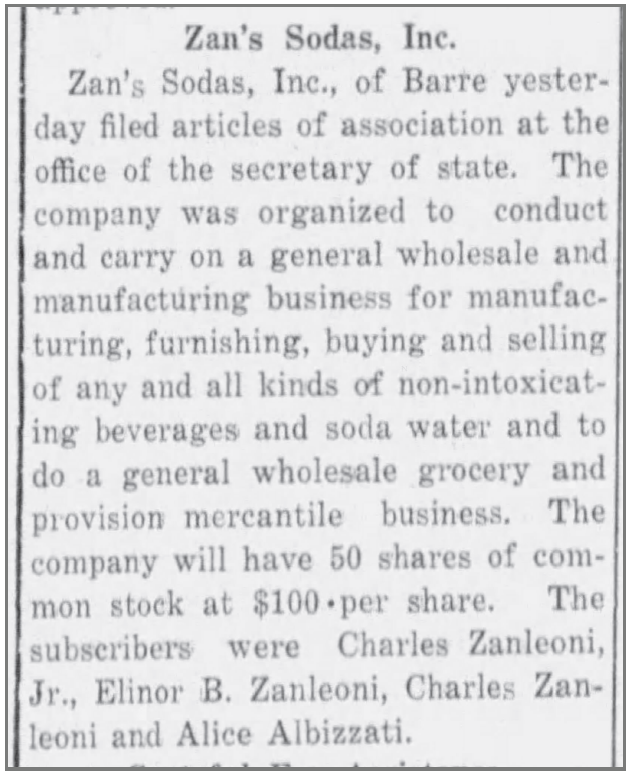
On January 28, 1936, Zan's Sodas, Inc. was incorporated in Barre. The company's articles of association authorized it to manufacture and wholesale carbonated beverages and soda water while also engaging in wholesale grocery and mercantile business. The incorporators were Charles Zanleoni Jr., Elinor B. Zanleoni, Charles Zanleoni, and Alice Albizzati.
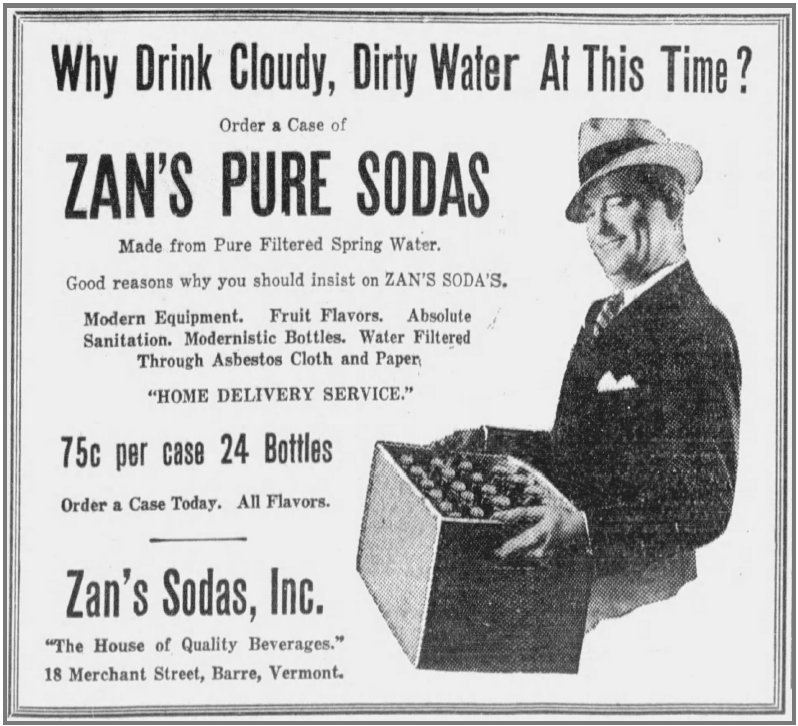
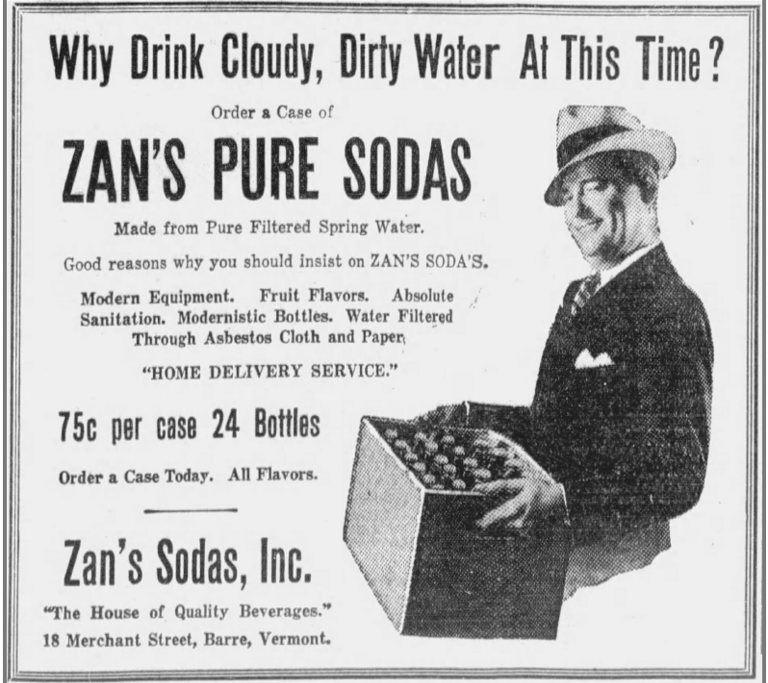
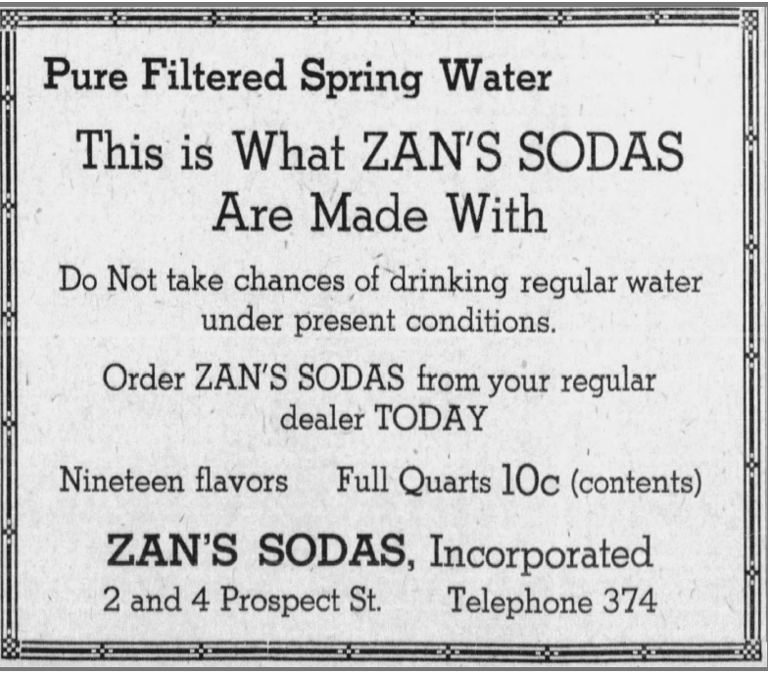
The young company wasted little time establishing itself. By the summer of 1936, Zan's was advertising its "Pure Sodas," emphasizing quality, cleanliness, and modern production methods. Those modern production methods included filtering water through asbestos! Zan's offered delivery service directly to customers from its plant at 18 Merchant Street.
Advertisements proudly stated that the beverages were produced using filtered spring water, sterilized bottles, and modern bottling equipment. Customers were encouraged to "Order a Case of Zan's Pure Sodas," with the company stressing that quality was the foundation of every bottle it produced.
Growing on Prospect Street
Business expanded rapidly.
Within a year, Zan's had outgrown its Merchant Street location and moved into a much larger bottling facility at 2-4 Prospect Street. The remodeled building represented a major investment in the company's future.
The new plant featured filtered spring water supplied from McFarland Spring, modern carbonation equipment, automatic bottle washers, bottling machinery, refrigerated storage, and loading facilities that allowed efficient distribution throughout the region.
By early 1937, the company employed eleven people and operated five delivery trucks serving much of Vermont. Company president Charles Zanleoni reported that the business had developed a substantial wholesale trade while continuing to serve local customers.
An advertising feature published later that year described Zan's as "the largest manufacturers of carbonated beverages in Barre," praising the company's hygienic production methods, quality ingredients, and dependable delivery service.
More Than Soda
As the business grew, so did its product line.
In late 1936, Zan's introduced a line of ready-made cocktail mixers, including Tom Collins, Ward Eight, and Rickey Mixer. Sold in quart bottles for ten cents, the products reflected changing consumer tastes following the repeal of Prohibition.
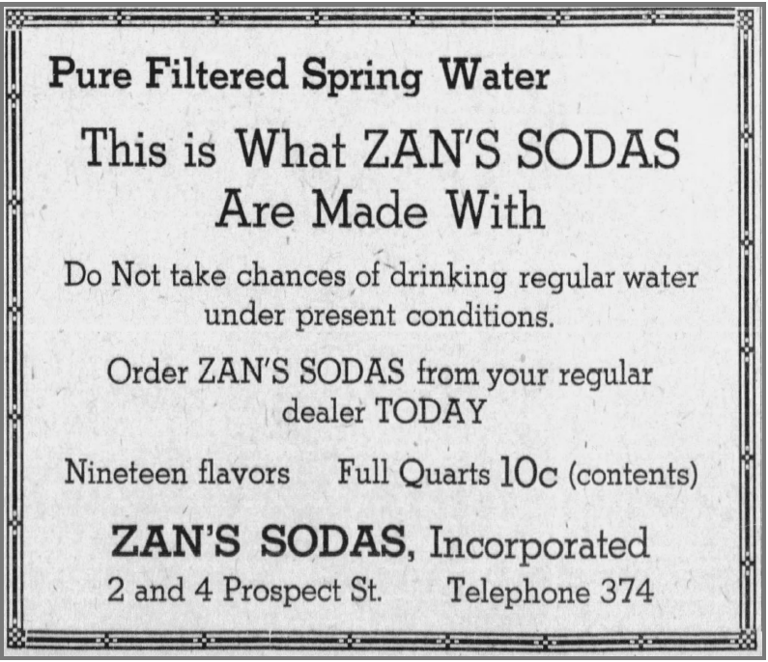
The company also continued expanding its line of flavored sodas. Advertisements listed an impressive assortment of beverages, eventually growing to nineteen different flavors, all promoted as being made with pure filtered spring water.
In 1938, the corporation amended its charter to authorize the wholesale distribution of beer and wines, further broadening the company's business beyond soft drinks.
A New Owner
A significant change came in March 1940.
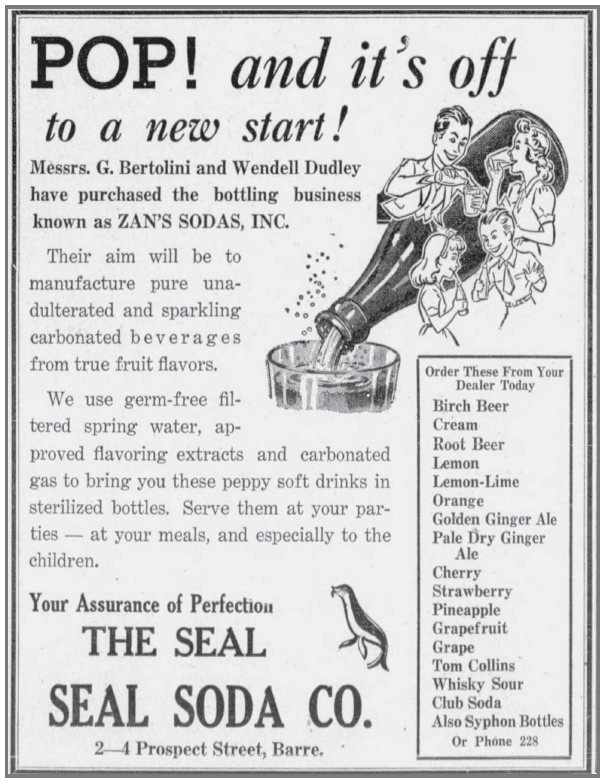
Charles Zanleoni sold Zan's Sodas to Guelfo Bertolini and Wendell Dudley. Newspaper accounts reported that the new owners intended to continue and expand the business while maintaining the quality that had become associated with the Zan's name.
Before long, the company adopted a new identity—Seal Soda Company.
Early advertisements promoted "Your Assurance of Perfection—The Seal," while assuring customers that the same emphasis on pure spring water, genuine fruit flavorings, and carefully sterilized bottles remained unchanged. The company bottled cream soda, root beer, birch beer, ginger ale, club soda, and a wide variety of fruit-flavored beverages, along with cocktail mixers.
Building a Regional Business
Throughout the 1940s, Seal Soda continued to grow.
A 1946 newspaper feature described the company as a locally owned bottling business operating from its Prospect Street plant. Bertolini and Dudley had originally organized as partners before incorporating the business in 1943.
Despite wartime sugar shortages, the company maintained its commitment to quality. Rather than reduce ingredients, Seal Soda chose to limit production of certain beverages until sufficient supplies became available. The article also noted the company's continued use of genuine fruit flavorings whenever possible.
Growth extended beyond the company's own products.
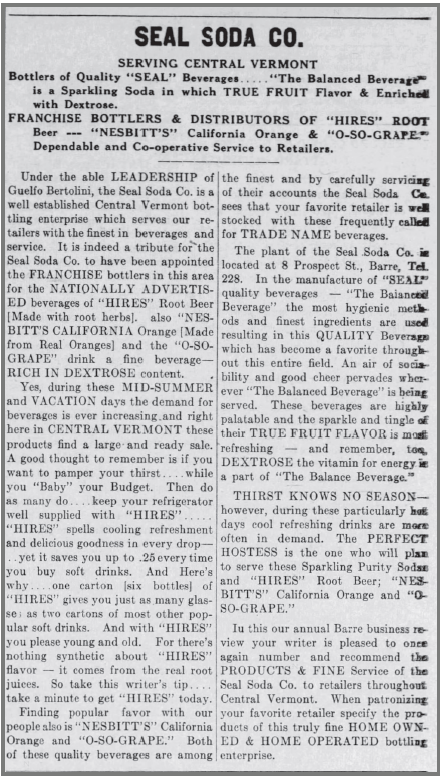
By 1949, Seal Soda had become the regional franchise bottler for nationally recognized brands including Hires Root Beer, Nesbitt's California Orange, and O-So-Grape. Advertisements described the company as serving retailers throughout central Vermont while continuing to bottle its own Seal beverages.
The company's success clearly inspired another local venture. In 1947, Guelfo's younger brother, Enzo Bertolini, established the Public Beverage Company on Prospect Street. Because of a post-war shortage of bottles, the new company utilized Seal Soda's large quart bottles while Seal continued bottling beverages in smaller individual bottles.
Fire on Prospect Street
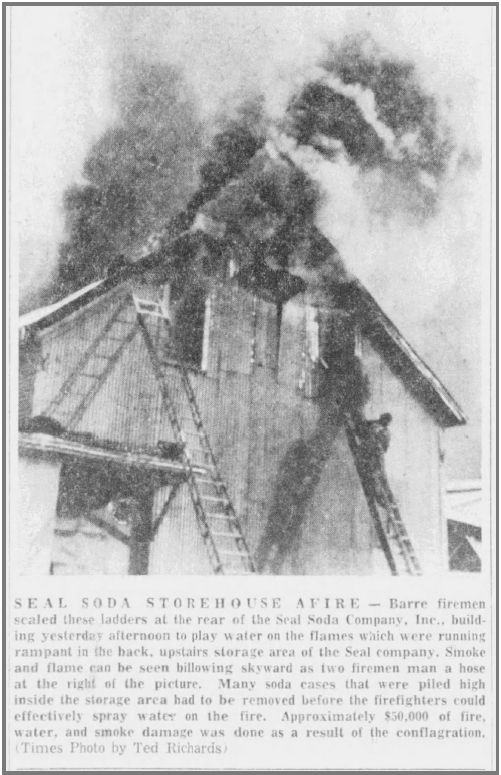
Disaster struck on January 31, 1956.
A fire broke out in the upstairs storage area of Seal Soda's Prospect Street building, sending thick smoke into the sky and drawing firefighters from across Barre.
The blaze caused approximately $50,000 in combined fire, smoke, and water damage. Seal Soda suffered losses to stored bottles, beverage cases, beer, wine, and the building itself, while the neighboring Barre Wholesale Grocery Company also sustained significant water damage. Firefighters were forced to remove stacks of empty soda cases, cut holes through the roof, and battle the fire from ladders positioned around the building.
Fortunately, the company's bottling equipment on the first floor escaped major damage.
Guelfo Bertolini reported that deliveries would resume almost immediately and that full bottling operations would likely be restored within a matter of days. The business was largely protected by insurance, allowing operations to continue despite the setback.
A Modern Plant
Rather than simply repairing the old facility, Seal Soda looked toward the future.
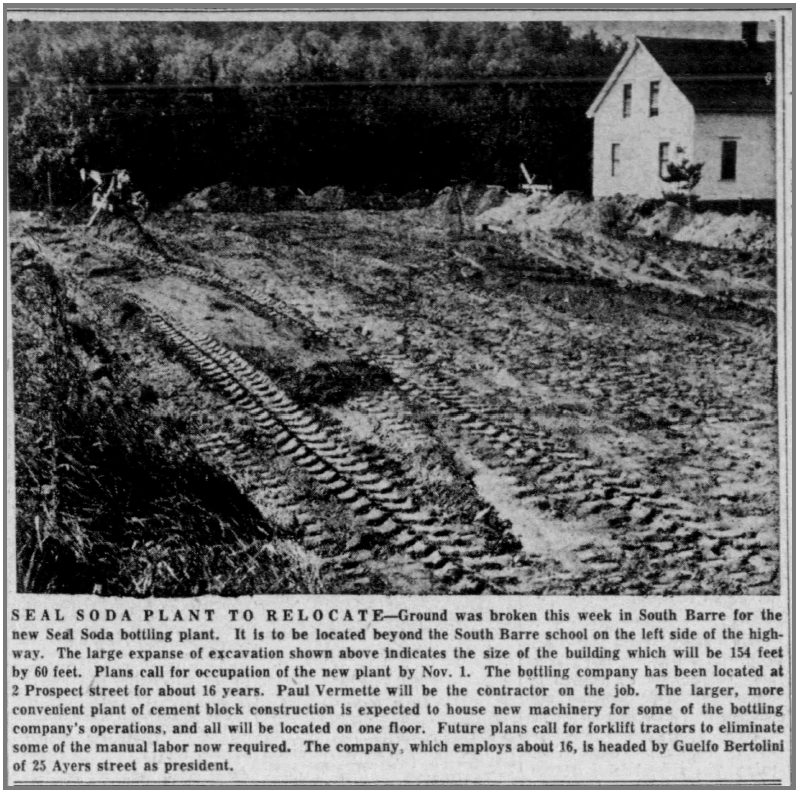
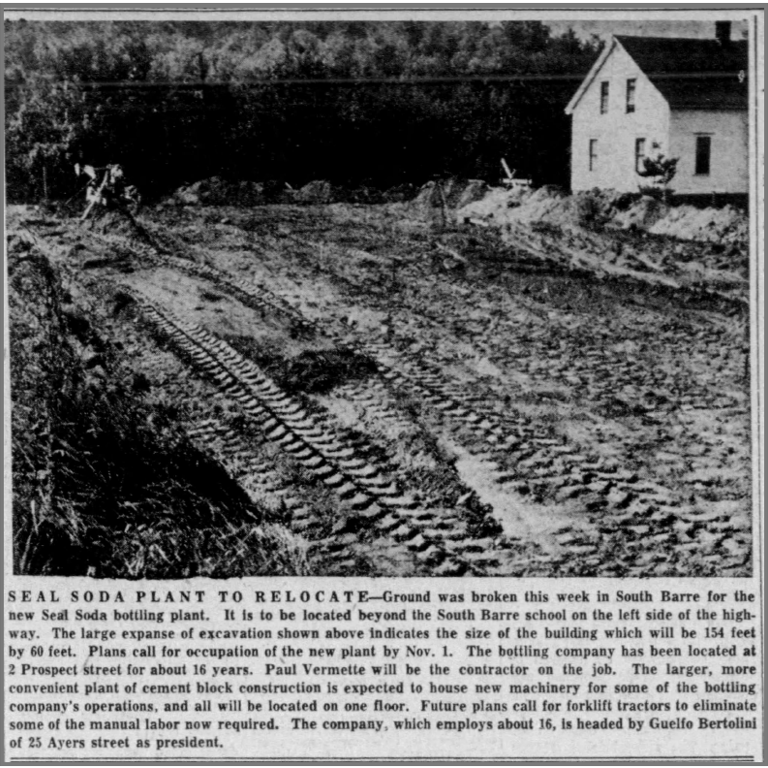
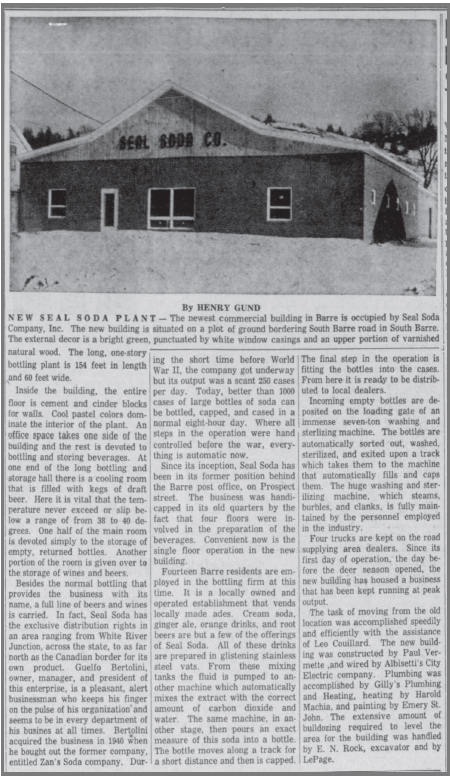
In August 1957, construction began on a new bottling plant in South Barre. The new concrete block building measured 154 feet by 60 feet and was designed to house the company's entire operation on a single floor. At the time, Seal Soda employed approximately sixteen people.
When the building opened later that year, it represented a dramatic modernization of the company.
Automated equipment washed, sterilized, filled, capped, and cased bottles with far less manual labor than had previously been required. Before World War II, the company had produced about 250 cases per day. In the new plant, production exceeded 1,000 cases during a normal eight-hour shift.
Four delivery trucks served retailers throughout the region, while refrigerated storage rooms held beer and soft drinks awaiting distribution. The article noted that Seal Soda's territory stretched from White River Junction north to the Canadian border for many of its products.
The Last Bottles
For nearly a decade, the South Barre plant represented the future of the company.
Then, during the summer of 1966, signs appeared that Seal Soda's long run was coming to an end.
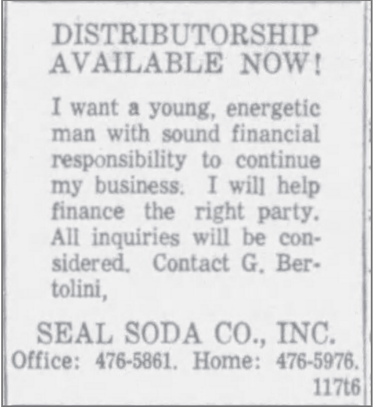
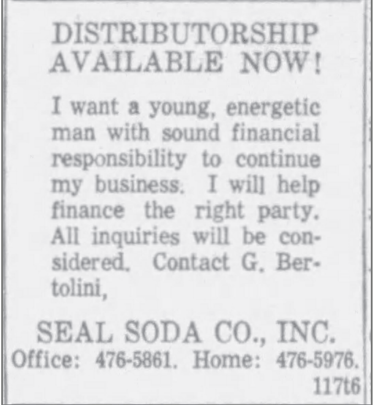
In August, Guelfo Bertolini placed an advertisement seeking "a young, energetic man" with sound financial responsibility to continue his business. He even offered to help finance the right buyer, suggesting that he hoped the company would continue under new ownership.
Just over a month later, the advertisements had changed.
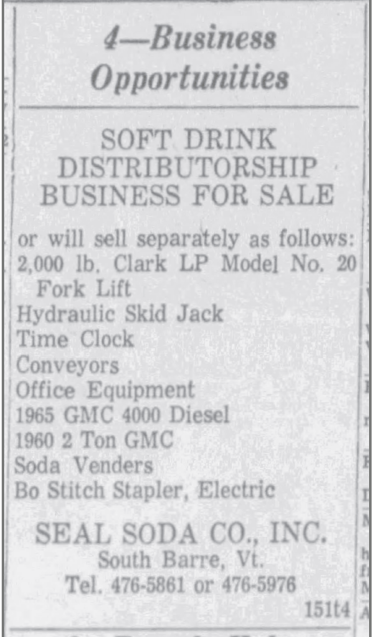
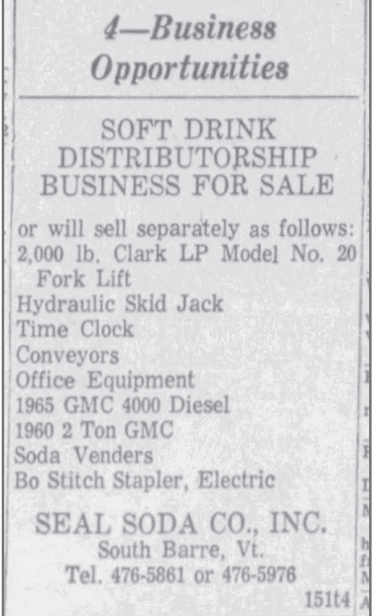
Instead of simply offering the business, Seal Soda announced that the entire soft drink distributorship was for sale—or that equipment could be purchased separately. The advertisement listed delivery trucks, a forklift, conveyors, vending machines, office equipment, and other business assets.
No newspaper article in the collection announces the formal closing of Seal Soda, nor does one identify a buyer who continued operating the company. Instead, the advertisements suggest that Bertolini's effort to sell the business as a going concern was unsuccessful and that its assets were ultimately offered individually.
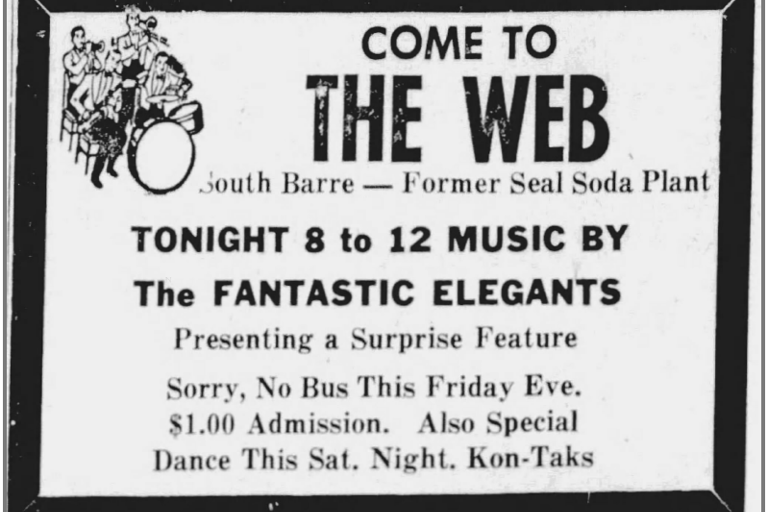
By early December 1966, advertisements were inviting patrons to dances at The Web, located in the "Former Seal Soda Plant" in South Barre. Within a matter of months, the sounds of bottling machinery had been replaced by live bands and weekend dances.
A New Chapter
Seal Soda may have disappeared, but Guelfo Bertolini's career did not end with the company.
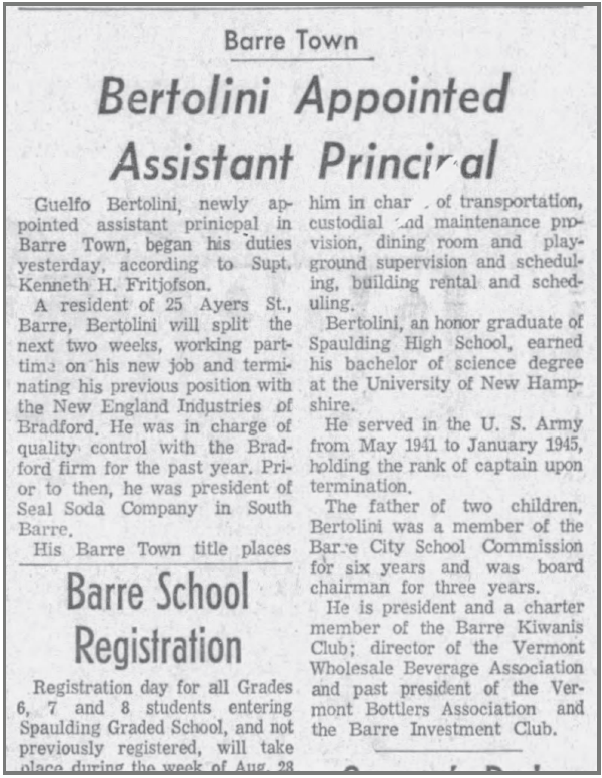
After leaving the bottling business, Bertolini spent approximately a year in quality control with New England Industries in Bradford. In August 1967, he accepted the position of assistant principal for the Barre Town School, where his responsibilities included transportation, maintenance, scheduling, and supervision of school facilities.
The newspaper announcing his appointment also highlighted his long record of community service. Bertolini had served on the Barre City School Commission, including three years as chairman, and remained active in the Kiwanis Club and the Vermont beverage industry.
Final Thoughts
Although Seal Soda quietly disappeared during the fall of 1966, its impact on Barre lasted far longer. Even today, posts occasionally appear on local Facebook groups asking about Zan's and Seal Soda bottles or seeking information about the company. With no Wikipedia page or official company history to tell its story, much of its legacy has remained scattered among old newspaper clippings and the memories of local residents.
Beginning as Zan's Sodas during the depths of the Great Depression, the company grew into one of central Vermont's leading independent bottlers. It survived wartime sugar shortages, expanded its distribution across much of the state, recovered from a devastating fire, and invested in a modern bottling plant before quietly bringing its operations to an end in 1966.
Today, few reminders remain of the company that once bottled thousands of cases of soda each day. Yet for three decades, the familiar pop of a Seal Soda bottle was as much a part of Barre as granite, the railroad, and neighborhood corner stores. Through the newspaper accounts and memories preserved by those who remember it, the story of Zan's and Seal Soda offers a glimpse into a time when local businesses supplied their own communities with products made right here in Barre.
Perhaps the company's greatest legacy is the entrepreneurial spirit of the people who built it. Charles Zanleoni transformed an idea into a successful hometown business. Guelfo Bertolini carried that business forward, expanding it into one of central Vermont's leading independent bottlers and investing in its future with a modern production facility. Their story is a reminder that innovation, hard work, and a willingness to take risks have long been part of Barre's history. Those are qualities worth remembering, celebrating, and inspiring in future generations.
Reach out with questions or to get involved
Phone
boutinforbarre@gmail.com
802-272-2858
© 2026. All rights reserved. Paid for by Michael Boutin, 5 Hillside Ave, Barre VT 05641